
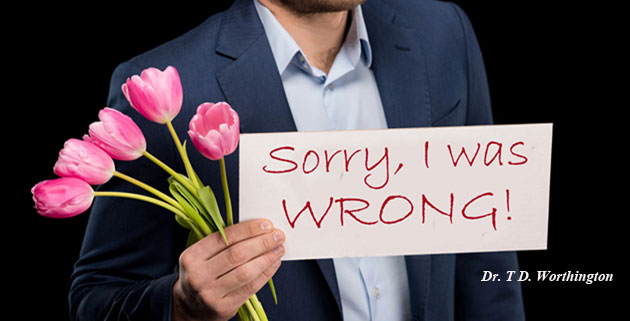
When you became a Christian, your first act was to accept Christ as your Lord and Saviour. You dethroned yourself; you renounced the flesh and asked our Lord to take His rightful place on the throne of your life. It would have been ideal if that were a one-time event, but you know it wasn’t. Although your salvation was secure, it marked only the beginning of your transformation into Christ’s likeness. And since that day, every step you’ve taken has called for a new and fresh renunciation of self.
One of the strongest signs that self overpowers us is a person’s difficulty in saying, “I was wrong.” Those simple words are so hard for some of us. Our Lord, who sets the example for us in many ways, can’t give us personal examples in this area because He was never wrong, so He never had to admit it. Of course, the Bible does give us quite a bit of instruction in this area. James 5:16 says, “Confess your faults one to another, and pray one for another, that ye may be healed.” Then we have Proverbs 28:13, which says: “He that covereth his sins shall not prosper: but whoso confesseth and forsaketh them shall have mercy.”
James mentions healing, and Proverbs mentions getting a fresh start. The Bible makes it sound so easy, but we all know it is not.
First, some people simply hate to admit errors. Some of us don’t like to admit we made a mistake. God says that confessing our sins and failures will grant us a chance to clean up the mess. It may take a little time to rebuild a damaged testimony, but over time, He can give us a fresh start. One of the hardest things to admit is when you were wrong about your internalized belief system. Everyone has a belief system, even non-Christians. Everyone believes the world operates in a certain way and follows specific rules. Maybe we grew up accepting certain things, so we base our lives on them, whether they are accurate or not.
“I was always taught that a person who curses after they are saved should be disqualified from ministry.” I don’t think Peter would agree. “I have always believed that a believer who commits adultery is marred for life.” David might argue that point. I am not condoning any of these things, but they are part of the internalized belief system of some folks, and it is hard for them to admit they are wrong. Some believe in salvation by works, confessing their sins to a priest, or fear losing their salvation, all because it is part of their internalized belief system.
It takes courage to admit you’re wrong, especially when it involves ideas you’ve held for years or beliefs of those you respect. It demands growth, rethinking your actions and values, and recognizing you’re wrong—if indeed you are.
The religious leaders who killed Jesus were unwilling to loosen their distorted theology enough to see that the Messiah would not be a conquering king, but a suffering servant. Those claiming to be the most godly people in Israel at the time, missed the Messiah because they refused to admit they were wrong. They wouldn’t change their beliefs to align with what God was doing.
Next, let’s talk about healing. Getting God’s forgiveness is easy, and while it may not always be as simple, asking for forgiveness from others shouldn’t be a major obstacle either. If you seek forgiveness, you confess, repent, and accept it. Then, it should be granted. Healing, however, is not always so simple. This is not about physical healing but emotional healing—a healing of the self and relationships. This kind of healing demands convincing yourself and others that you are truly repentant.
I Was Wrong, But…
This is when our creative streak really begins to show. “I was wrong, but it was your fault. Or perhaps, “Someone deceived me, so it was their fault”—or a thousand other reasons you did what you did. The fact is, all that might be true, but that kind of thinking will hinder real healing. Your thoughts and feelings aren’t the only ones that matter. Even if you believe you’re only 5% responsible and the other person was 95% wrong, you still need to accept your part. God holds us accountable for our mistakes, not for someone else’s. You should focus on your 5% and acknowledge it to whoever it needs to be acknowledged to.
If we don’t take responsibility and admit our role in failure, others won’t be motivated to help us heal and restore. Why would they? Sometimes, even when we are at fault, we still like to control the narrative. “I did wrong, and I want you to restore me, but you must do it my way.” Have you ever known someone like that? A person who, even amid failure, is still controlling, manipulative, self-absorbed, and insensitive towards others, and pushes to achieve their own agenda. Such a person usually cares mainly about themselves and sees others only as a means to an end.
Often, such a person cannot enjoy a mature, loving relationship because his thoughts are so self-focused. He knows little about sacrificial love for the benefit of others. He does not understand how to love unconditionally. He only gives to receive. He attempts to manipulate situations to serve his own selfish interests rather than those of others. People are seen as objects to be controlled, not individuals to be loved. Such a person will never experience genuine healing.
Finally, Let’s Talk About A Fresh Start.
Often, the quickest way to rebuild a relationship is by admitting mistakes. But why in the world would anybody risk that kind of honesty? Simple, because it’s worth the risk. The fresh start begins as we set aside this burden of “having to be right” and “fear of being wrong.” When you realize you’re wrong, dare to admit it. Do you remember when the curtain was lifted? It was then that the Wizard of Oz had the most to offer those who came seeking his help.
Now, I wish I could tell you that everything will always turn out fine if you confess and repent of your failures. However, it doesn’t always work that way. Many times, admitting our guilt might still lead to a termination, a divorce, a loss of friendship, or some other painful consequence. Still, it doesn’t make sense to excuse our failures and avoid that day of reckoning. We all make mistakes—many of them. We all sin and make poor decisions. We are all likely to stumble. But that’s what the process of becoming more like Christ is about—Christians constantly working to step down from the throne of their lives and instead enthrone Christ, aligning their lives with God.
So, when was the last time you admitted to someone that you were wrong? Wrong, with no excuses and no hold-backs.
Dr. Worthington has been in the ministry for nearly fifty years and serves as President of Pathway Ministries and Christian Bible College.