
 If I hadn’t seen it, I wouldn’t have believed it! One of my students told me that her dog had eaten her homework slip. I looked at her with the look that says, “Really?” She should know better than to expect me to fall for that one. But guess what? She pulls out a half-eaten homework slip Continue reading “Stop Making Excuses, Start Making Changes”
The Signature Of God

There are certain things that have the signature of God all over them. It might be a beautiful sunrise, a star studded evening sky, or the power of the crashing thunder. To me, all of these things give testimony of God. However, it is in the resurrection of Jesus Christ where I see the hand of God at work in a most profound and powerful way. In other words, it has His signature all over it.
Two of the clearest examples of His signature are in the paradox and power of the resurrection. Let’s consider first the paradox.
There Was A Paradox Signature.
In other words, God will often do things which defy human logic or understanding. The Bible states that God’s ways are not our ways and His thoughts are not our thoughts. Clearly we do not have the understanding to know why God does things the way He does. For example, sometimes God reveals things that might be downright embarrassing. The Bible is not written as a man would write it, especially when dealing with heroes. Consider the account of Noah, Elijah, David, Peter, or Thomas. There were certainly many embarrassing moments in their lives that were recorded in the Scriptures. This is also clearly demonstrated in the resurrection. Consider for example:
The First Eyewitnesses were Women. All the Gospels note that the first individuals to discover the tomb empty were women. Although you and I may not see any problem with this, it was a problem in that era. Women were not held in high esteem. In that culture, a woman’s testimony was not admissible in court. In Jewish circles, it took the testimony of two women to equate to that of one man. If one were to invent a story, the last people one would place as the first witnesses would have been women. But that sounds just like God to me!
Historically speaking, embarrassing details add veracity to a historical claim. The fact that women were the first witnesses, generally speaking would not have been a good idea. Apparently, God thought otherwise.
Another embarrassing detail would be that a member of the Sanhedrin (the same Sanhedrin that executed Jesus) had to give Jesus a proper burial. The fact that the disciples were fearful and fled serves as an embarrassing factor for the resurrection account. After His crucifixion, Jesus was buried in a tomb by Joseph of Arimathea. This fact is highly significant because it means that the location of Jesus’ burial site was known to Jew and Christian alike. People were free to go and publically witness the sealed tomb, and later the empty tomb.
But, that’s not all. As a member of the Jewish court that condemned Jesus, Joseph of Arimathea is unlikely to be a Christian invention. There was strong resentment against the Jewish leadership for their role in the condemnation of Jesus (I Thessalonians 2:15). It is therefore highly improbable that Christians would invent a member of the court that condemned Jesus to be a hero. Strangely, it was a member of a group antagonistic to Jesus who honored Him by giving Him a proper burial instead of allowing him to be dispatched as a common criminal.
Another paradox was that there was no human motive for the resurrection. Well, some think the disciple’s created a conspiracy to start a new religion, but this makes no sense. When a conspiracy is formed, three motivating factors are usually behind such a move; power, greed, or lust. It may be one of these, two of these, or all three of these, but they will be somewhere in the equation. The disciples would not gain any power behind claiming the resurrection as history. Their preaching was making them strong enemies. They were constantly threatened by the Jewish and Roman authorities. Their power as citizens was actually decreased because of their preaching. Greed certainly could not have been a motive. They taught one should not desire earthly possessions, but spiritual ones. There is no record of a thirst for riches by the early disciples. Lust was not a factor, either. Their message taught celibacy before marriage and fidelity after marriage. So what was the point of a conspiracy? There was nothing in the earthly realm to gain.
The conclusion is that in the resurrection the disciples had no tangible motivation behind claiming Jesus had risen from the dead. We can find no reasonable motivating factors existing for these disciples to invent such a story. The only reason the disciples proclaimed the resurrection of Jesus as a fact was because His resurrection had actually occurred.
Secondly, There Was Also A Power Signature.
First, this was a real resurrection. You might be thinking about Lazarus or others, who just like Jesus, were resurrected from the grave. Well, not exactly. Jesus did not, like Lazarus, simply get up and walk out from the burial crypt and resume life in ordinary time. With Jesus, His closest friends didn’t recognize him, not even Mary Magdalene. He was different now, no longer mere human flesh. Jesus could walk through closed doors. Lazarus couldn’t do that. Jesus was not bound by the earthly laws of gravity and matter, Lazarus was. Although any resurrection qualifies as a miracle, the resurrection of Christ was different.
Second, there was life transforming power released. God changes things. Changing the water into wine is just one example. But, God has always preferred to change people instead of things. For example, James, the brother of Jesus, was changed from a skeptic to a believer because of the resurrection. James along with his brothers did not believe in Jesus during His early ministry (John 7:5). However, after the resurrected Lord appeared to him, (I Corinthians 15:7) James became a leader in the early Jerusalem church.
Paul is another example of one who was completely transformed by the resurrection of Jesus. Paul had been a persecutor of the church. After witnessing the risen Jesus, Paul became a great evangelist for the infant church.
The resurrection of Christ changed, and continues to change lives. Of course, it also changed a few other things in the process. The practice of the early church in observing baptism, the Lord’s Supper, and Sunday worship all point to the resurrection. Baptism is an illustration of the death, burial, and resurrection of Christ. The Lord’s Supper is a symbol of Christ’s sacrificial death. In addition, it is quite odd that faithful Jews would move their worship from Saturday to Sunday unless something major had occurred on that particular day. The major Sunday morning event that changed their day of worship was the resurrection. All of this attests to the power of God at work changing things that only God could change.
Also, the resurrection is one of the major evidences that Jesus Christ is the Son of God. Paul affirmed that Christ is “declared to be the Son of God with power . . . by the resurrection from the dead” (Romans 1:4).
The resurrection also represents an assurance that we can have forgiveness from our sins. Paul contended: “And if Christ be not raised, your faith is vain; ye are yet in your sins” (I Corinthians 15:17). The reverse of the apostle’s affirmation would be this: if Jesus was raised, sins will be forgiven when we obey the gospel.
Next, the resurrection tells the world that the kingdom of God is ruled by a living sovereign. The founder of Islam is dead and his bones lie dormant in the earth. But the founder of Christianity sixty years after his death appeared to John on the island of Patmos and said: “I am he that liveth, and was dead; and. Behold I am alive for evermore” (Revelation 1:18).
The resurrection proves that physical death is not the termination of human existence. God, who is the giver of life, has the power to reanimate and glorify the human body. Christ’s triumph over the grave is Heaven’s pledge to us that we too shall be raised. This is why Jesus is referred to as the “firstfruits of them that slept.” (I Corinthians 15:20).
Finally, the Lord’s resurrection previewed the ultimate victory of Christianity over all its enemies. In the book of Revelation, Jesus is depicted as a lamb that had been slain, but was standing again. This same Lord was “the lion of the tribe of Judah” that had overcome his foes. Christians too will overcome as a result of the Lamb’s sacrifice and victory over death (Revelation 12:11).
The resurrection of the Son of God should be a constant reminder to us of these wonderful biblical truths. We honor our Master’s victory over death, not just once a year but every day, and especially on the Lord’s Day. The earliest Jewish allegation that the disciples had stolen Jesus’ body shows that the body was in fact missing from the tomb. The earliest Jewish response to the disciple’s proclamation, “He has risen from the dead!” was not to point to his occupied tomb (they clearly knew where it was) and to laugh them off as fanatics, but to claim that the disciples had stolen the body. Thus, we have evidence of the empty tomb from the very opponents of the early Christians.
Actually, the resurrection only requires us to believe on one thing: it requires only one belief: that God exists. The resurrection of Jesus from the dead is the foundation of the Christian faith. If there was no resurrection, Christianity is a hoax, and we are wasting our time. But the truth is, the resurrection of Jesus Christ is one of the clearest facts of human history. After all, it has the signature of God all over it!
Dr. Worthington has been in the ministry over forty years and serves as President of Pathway Ministries.
The Choices We Make

How many pillows do you use to sleep? I use at least two. One pillow is for my head and the other is for my knees. At my age certain parts of my body ache just to aggravate me. When I was young, I would get sore when I worked hard outside or taxed my body. I was over the soreness much quicker then and always ready to spring back into action. Nowadays it takes a couple of months to get over being sore. I don’t bounce back as quickly as I used to. Continue reading “The Choices We Make”
New Beginnings

As we usher in the New Year, different thoughts go through our minds. Some people view January 1st as just another day, while others view it as a time of new beginnings. Many of us set all kinds of resolutions, and some just want a chance for a fresh start. Either way, we all have areas we need to work on in our lives, and the new year is a good time to start. We have had or will have many new beginnings in our lifetime. Continue reading “New Beginnings”
The Carpenter’s Son
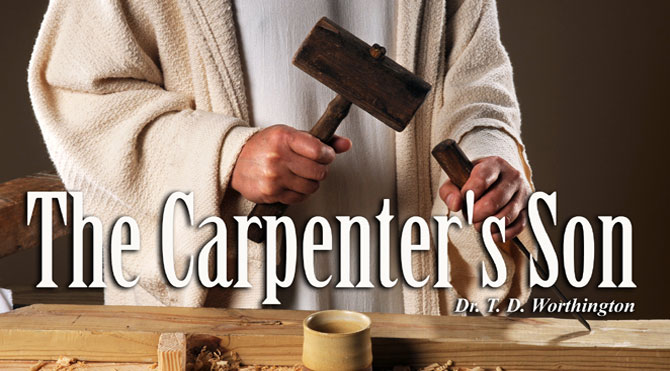
My name is Joseph, and I wonder if you know my son? His name is Jesus. Oh, I know He is not technically or biologically my son. I know He is the Son of God. I also know He had a relationship with God the Father from eternity past—long before I knew Him— and it continues to this day. But, long before He was known as the Son of God, in our little town He was known as the Carpenter’s Son…my son! I loved Him as a son, treated Him like a son, and taught Him like a son. Furthermore, Jesus respected me and honored me as His father.
Just as our Heavenly Father was well pleased with Jesus, so was I. I took my responsibility as a father seriously, not just to feed Him and care for Him, but also to teach Him a skill. Now, you might think that was a waste of time. We both knew His main mission in life was not to have a career as a carpenter, yet still He was obedient and willing to learn—and I would have failed in my responsibility as a father if I had not taught Him. You see, Jesus was a part of a family, and when you are a part of a family certain expectations are made and responsibilities are required. He was expected to participate in the family business. Actually, His early training in the carpentry shop greatly influenced His teachings later in life.
Back in my day, boys often began their formal apprenticeship around 12 years old. They usually learned a trade from their father. Training stretched over many years. Like a good student and obedient child, Jesus put forth intense effort to develop the necessary skills to become a master carpenter. I fondly recall the many pleasant hours I spent with Jesus—working with Him, conversing with Him, and passing on my expertise to Him. Some of the things my father taught me, I would end up teaching Him. Oh, how I watched with pride as Jesus mastered the craft!
Carpentry is not an easy job. Knowledge, strength, skill, and a lot of common sense are required to be a good carpenter. It is not as simple as it looks. A carpenter needs to know the characteristics of the wood he works with. We could choose from locally grown timber, such as cypress, oak, cedar, sycamore, and olive. However, we could not just visit a lumber yard or a building supply store and pick up lumber cut to our specifications. Rather, we would travel to the forest, select the appropriate trees, fell them, and then haul the heavy logs back to the workshop. As I got older more of this heavy work fell on Jesus—and later on His younger brothers.
What might a carpenter produce from the lumber we gathered? Sometimes we would spend many hours outdoors helping to build houses. Although many houses were built of stone, and most all except the houses of the foolish would at least have a rock foundation, we would still need to mill rafters for the roof, manufacture stairs for the interior, and make doors, windows, and frames for the walls.
A carpenter would also produce furniture. We would build things like chairs, stools, tables, cabinets, and cradles. Not all of these items were of simple design. Depending on the budget of the buyer, we might inlay the item with differing types and colors of wood. We might use our skills to carve intricate patterns and designs in the wood. To protect and beautify the items, we might coat them with beeswax or oil.
A carpenter also made products for the local farmers. We would make yokes, forks, rakes, and shovels. We might fashion plows strong enough for their iron points to gouge furrows through the rocky soil. On occasion we made wooden carts and wagons and crafted the solid or spoked wheels upon which those vehicles rode. Occasionally, we might also labor repairing and maintaining the furniture, tools, and vehicles we made. Sometimes, there was emergency work to be done. I remember once when a farmer came to our shop with a broken plow. It was in prime planting season and the plow had to be fixed to plant the seed. I asked the fellow what caused the plow to be broken. He explained that he just turned aside for a moment—took his eye of the plow for a second—and the plow hit a big rock in the field and splintered. The farmer said that no man was worthy to be called a plowman if he couldn’t keep his eyes on the plow. I remember the impression that made on Jesus as he was given the responsibility of repairing that plow.
There were other times when carts had to be repaired for the short harvest season, before the rains began to fall. Sometimes there were late nights in the carpentry shop. Mary would sometimes bring us a late night snack as we labored to finish a job by the deadline.
I saw my son grow into manhood in the carpentry shop. His skin was bronzed by the Middle Eastern sun, His muscles strengthened by years of physical labor, and His hands hardened from gripping rough wood and wielding axes, hammers, and saws. He was strong. He also had an eye for good craftsmanship. Every joint had to be fitly joined together.
His Personal Toolbox
A first-century carpenter would need to know how to handle the tools of His trade. We had some common tools that both Jesus and I would use, but soon I began to purchase tools exclusively for Him. First I made Him a little toolbox and fashioned Him a small hammer. Later, He acquired some serious tools. I got Him a saw, consisting of a wooden frame holding an iron blade with teeth set in a way that would cut on the pull stroke. He would use a square to lay out His work and a plumb to line up vertical surfaces. Also in His toolbox was a level, a rule stick, a plane with its sharp, adjustable iron blade for smoothing rough lumber, and an ax for cutting down trees. He also had a lathe and gouge used for cutting and shaping spindles. He had a wooden mallet used for pounding dowels into joints or for driving chisels. He had a drawknife and a bow drill.
He Used Many of My Teachings in His Ministry
Now, we all know the influence of His Heavenly Father—and I take nothing away from that. But, I am also quite proud of the influence I had on His life. Jesus would later masterfully use simple, familiar objects to teach deep spiritual truths. Personally, I think He drew on his background as a carpenter for some of His greatest illustrations. I remember when He was still quite young He got a speck of sawdust in His eye. It obviously hurt, so I sat Him down on a beam, Mary went to fetch some water, and we washed the speck out of His eye. I explained that this was one of the hazards of the trade, but a least it was just a speck—I reminded Him as I tapped the beam He was sitting on—that it could be a lot worse. Mary didn’t appreciate my humor, but Jesus smiled and agreed. Later, He would give this very example: “Why, beholdest thou the mote (speck) that is in thy brother’s eye, but considerest not the beam that is in thine own eye?” Matthew 7:3
As a carpenter, He knew how massive a beam was. Later, Jesus said to another group: “No man having put his hand to the plough, and looking back, is fit for the kingdom of God.” Luke 9:62 I think He recalled the numerous broken plows He repaired; sometimes broken by carelessness. One of Jesus’ warmest invitations involved a piece of equipment manufactured by a carpenter. “Take my yoke upon you and learn of me,” said Jesus. “My yoke is easy and my burden is light.” Matthew 11:29, 30 I taught Jesus how to properly make a yoke. I explained that the yoke must be made to fit the oxen. It must be measured to fit the animal and designed depending on the burden he was to bear. Jesus knew how to make a yoke that did not chafe but was well-fitted to the animal—so as to make his burden light.
Is Not This the Carpenter’s Son?
Now, I am proud to be a carpenter. It is an honorable profession. However, when Jesus’ enemies referred to Him as “The Carpenter’s Son” they meant it as an insult. They are asking disdainfully, “Who does He think He is?” Is He not a common worker with His hands even as the rest of us are? Even more, we hear the opinions of rulers, religious authorities, crowds, disciples, and even family members; “Is not this the carpenter, the son of Mary…” Mark 6:3. They were asking could a child of such an undistinguished heritage be such a powerful prophet—much less the Messiah.
The additional phrase “the son of Mary” was also most hurtful and disparaging. It was contrary to Jewish usage to describe a man as the son of his mother, even when she was a widow. People were normally referred to as the son of their father. It was their way of implying He was illegitimate. Rumors to that effect were always surfacing—every time we thought they had died down—they came back up again. The townspeople are scandalized by the human origins of Jesus, whom they know as a carpenter.
He Was Known As a Carpenter
However, that does bring me to one great point. It was a proud moment for me. It somewhat validated my training as a father when Jesus became a carpenter in His own right. “Is not this the carpenter”, is actually a question in Greek that expects a positive reply. He was known as a “craftsman” (tekton). He learned the skills I taught Him well enough to be considered a carpenter in His own right. When Jesus visited His hometown of Nazareth, He is actually called a carpenter by the local residents. In the normal course of events, Jesus became a carpenter Himself and lived for a while in fulfillment of that role. Later, He merged the roles of His Heavenly Father and earthly father together and became the greatest builder since the Creation.
In Matthew 16:18 Jesus makes a promise that involves the greatest building project ever undertaken. In response to Peter’s confession that He was the Christ, the Son of the living God, Jesus declares, “On this rock I will build My church, and the gates of hell shall not prevail against it.”
The Scriptures go on to reveal that Jesus fulfilled His promise to build a church. He purchased the material from which His church was built. In speaking to those who made up the church in the city of Corinth, Paul assures them that the foundation upon which they were established is none other than Jesus. Jesus built the promised church. He alone became the architect, builder, owner, and Lord.
Some wonderful details of the church that Jesus built are provided in Ephesians 2:19-22. “Now therefore ye are no more foreigners, but fellow citizens with the saints, and of the household of God; and are built upon the foundation of the apostles and prophets, Jesus Christ himself being the chief corner stone. In whom all the building fitly framed together…”
Notice how various points about the house that Christ constructed are made through the carefully chosen language of the passage.
The word “foreigners” originally meant something like “alongside the house” in the sense of “separated from or away from the main house,” almost like an outbuilding. But now, Paul points out that the Gentiles are now an integral part of the household of God. It is an accomplished fact that the Gentiles are in Christ, as their place in it is spoken of in the past tense with the word built. Paul says that the whole building will grow into a holy temple in the Lord, emphasizing the living aspect of the building.
Jesus, my Son—the son of a lowly carpenter from Nazareth thus becomes a great builder. He has built a living and continuing house that we can all benefit from and become a part of. Do you know Him?
As a father, when I see the influence I had over Jesus when He was growing up, I stand amazed. Knowing He was the Son of God, and here on a divine mission, I sometimes wondered if I was wasting my time—and His time—teaching Him how to fashion a piece of lumber. But, I was not wasting time. Jesus used the things I taught Him. They became a lasting influence over His life and He used those lessons to help others. And, even if He had not used my lessons, I still had a responsibility to teach Him. After all, that’s what fathers do.
(Originally written as a 2017 Father’s Day message.)
Dr. Worthington has been in the ministry over forty years and serves as President of Pathway Ministries.
Thank You Cards
 We are living in an unthankful generation. Perhaps this is no clearer evidenced than by the demise of the humble “Thank You Card”.
Years ago, thank-you notes were an art form. They were personal, timely, and genuine. In other words, there was a certain etiquette which had to be followed in sending thank you notes. Unfortunately, receiving a handwritten thank-you note seems to be increasingly rare. Continue reading “Thank You Cards”
But If Not…

It is lurking like a shadow over my head. Every time I turn around it raises its ugly head. I think I have beaten it, and it returns again. Why can’t I escape this feeling inside? I have never been afraid of storms before. By the time you read this article, we will know the results of Hurricane Irma. I am praying it will go out to sea. But if not….. Continue reading “But If Not…”
Yes Lord… I Am Ready!
 “Ok, Lord! I think I am ready for this! School has been in session for a couple of weeks, and I have already recognized my new challenges.” Each new school year I get new ones in addition to the old ones I am already experiencing. I have been teaching so long one would think I would have it mastered. It would be nice to have an easy year, but what is the fun in that? Continue reading “Yes Lord… I Am Ready!”
A Word Behind Thee

“And thine ears shall hear a word behind thee, saying, This is the way, walk ye in it. . .”
Isaiah 30:21
World War I, often called the Great War, was so horrible that people began to call it the “war to end all wars”. Learned men began to acknowledge the cost of war was just too great for men to use conflict as a reasonable means of settling their disputes. Weapons were becoming too destructive. Men were promoting the use of airplanes and chemical weapons against their enemies. Bombs were becoming more powerful. Casualties were no longer restricted to the battlefields. Civilians were dying by the thousands. Surely, with all of man’s knowledge and evolutionary progress, he could find a way to avoid such carnage in the future. Countries should be wise enough to learn from history that war is a game where everyone loses. Continue reading “A Word Behind Thee”
In Her Eyes

“The light of the eyes rejoiceth the heart.”
Proverbs 15:30
The glow from an eye that shows a pure and joyful disposition, rejoices the heart of him on whom it is turned. There is something infectious in the joyful look of another. It has a cheering effect upon those who observe it. We all want to see that light in the eyes of those we love, and when we see it our heart rejoices. Continue reading “In Her Eyes”